
When code is free, the moat is everything the model isn't.
At AGI Summit 2026, Crunchbase's CPO and a Blitzscaling Ventures GP gave two independent talks that converged on one map: when code and models are commodities, the durable edge is proprietary data, community, workflow embedding, distribution, and network effects — everything the model isn't. Field notes from the Palace of Fine Arts, with the H1 2026 funding data underneath.
A defensible AI startup in 2026 is built from the assets its model can't supply: proprietary data, a community, a seat inside the customer's workflow, distribution, and network effects. The model itself — and the code around it — is now the cheap part.
That was the consensus hiding in plain sight at AGI Summit 2026 (July 18–19, Palace of Fine Arts, San Francisco) — the first of the two Bay Area summits we announced we'd be attending. Two talks, given independently — one by the executive who ranks startups for a living, one by the investor who underwrites them — converged on the same map of what survives when intelligence gets cheap.
The signal
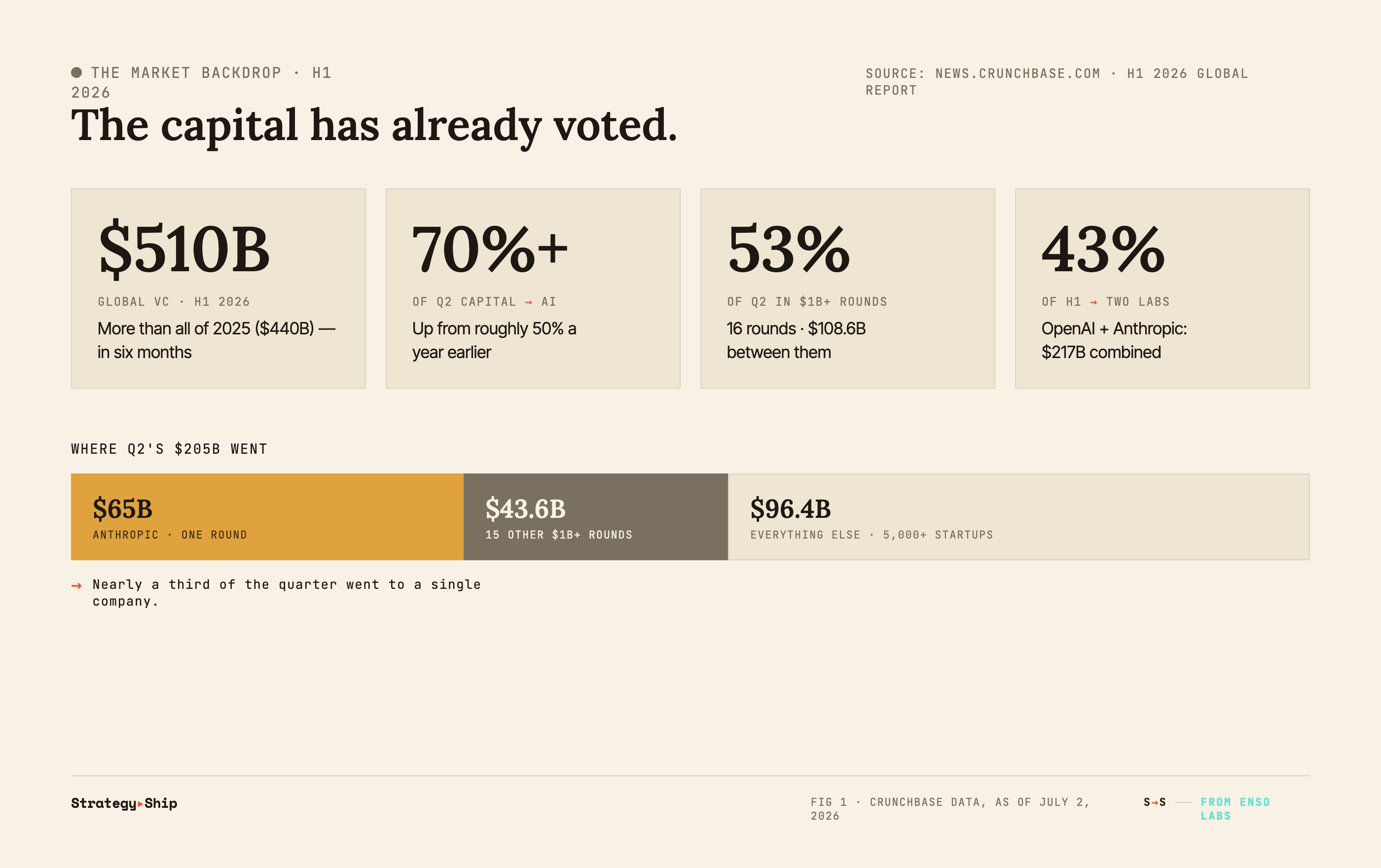
Ketaki Rao, Crunchbase's Chief Product Officer, opened "How to build a fundable AI startup" with a paradox from her own data: there is more venture money than ever, and it is harder than ever to get. Global startup funding hit a record $510 billion in H1 2026 — more than all of 2025 combined — but the money is pooling, not spreading. More than 70 percent of Q2 capital went to AI companies, up from roughly 50 percent a year earlier. Just sixteen billion-dollar-plus rounds took 53 percent of the quarter. And two companies — OpenAI and Anthropic — absorbed $217 billion, 43 percent of everything raised in the half.
For everyone not named OpenAI or Anthropic, Rao's answer is a five-part screen: a real market, sharp positioning, a defensible moat — proprietary data feeding learning loops, embedded in the customer's workflow, with distribution — momentum, and narrative. Then she showed the room what Crunchbase's scoring — the machinery behind its Heat Score — sees in the average AI startup today: Narrative 82, Momentum 74, Market 68, Moat 65, Differentiation 53. Read that ranking again. The story is the strongest thing about the average AI startup. The defensibility and the differentiation are the weakest.
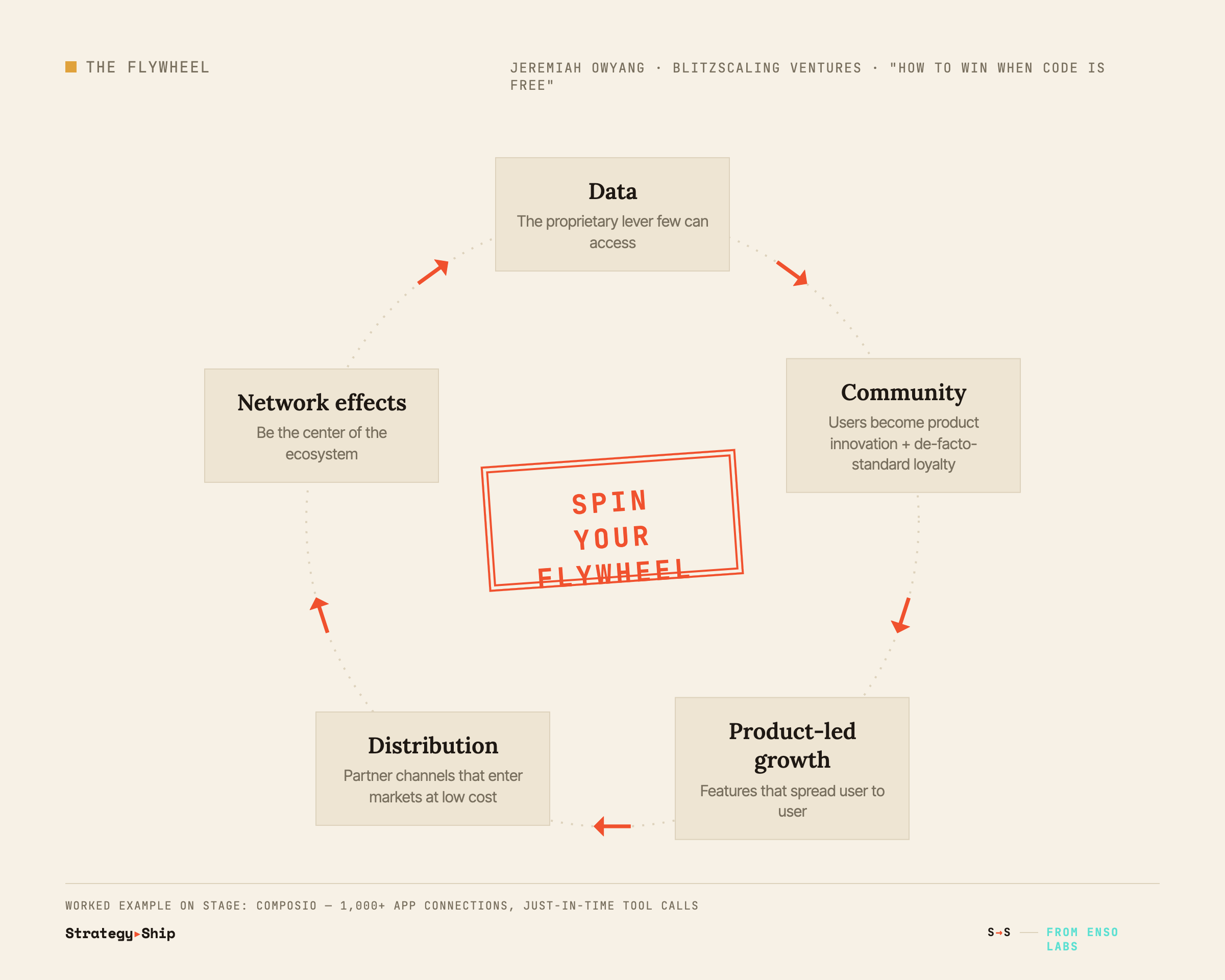
A day later, Jeremiah Owyang — General Partner at Blitzscaling Ventures — gave the investor's version in "How to Win When Code Is Free". His premise: code is now a commodity — a clever technical lead gets copied in weeks — so he underwrites the flywheel instead: Data → Community → Product-led growth → Distribution → Network effects, each stage feeding the next. Data is the proprietary lever few can access; community converts users into product innovation and de-facto-standard loyalty; product-led growth is features that spread user to user; distribution is the partner channel that enters markets at low cost; network effects put you at the center of the ecosystem. His worked example was Composio, whose 1,000-plus app connections and just-in-time tool calls make the integration graph — not the code — the asset a competitor would have to rebuild. His closing instruction to the room: spin your flywheel.
Why it matters
Put the two talks side by side — the mapping is ours — and they trace the same map, drawn from different directions:
| Rao's fundability screen | Owyang's flywheel stage |
|---|---|
| Proprietary data + learning loops | Data |
| Momentum | Community |
| Embedded in the workflow | Product-led growth |
| Distribution | Distribution |
| Defensible moat | Network effects |
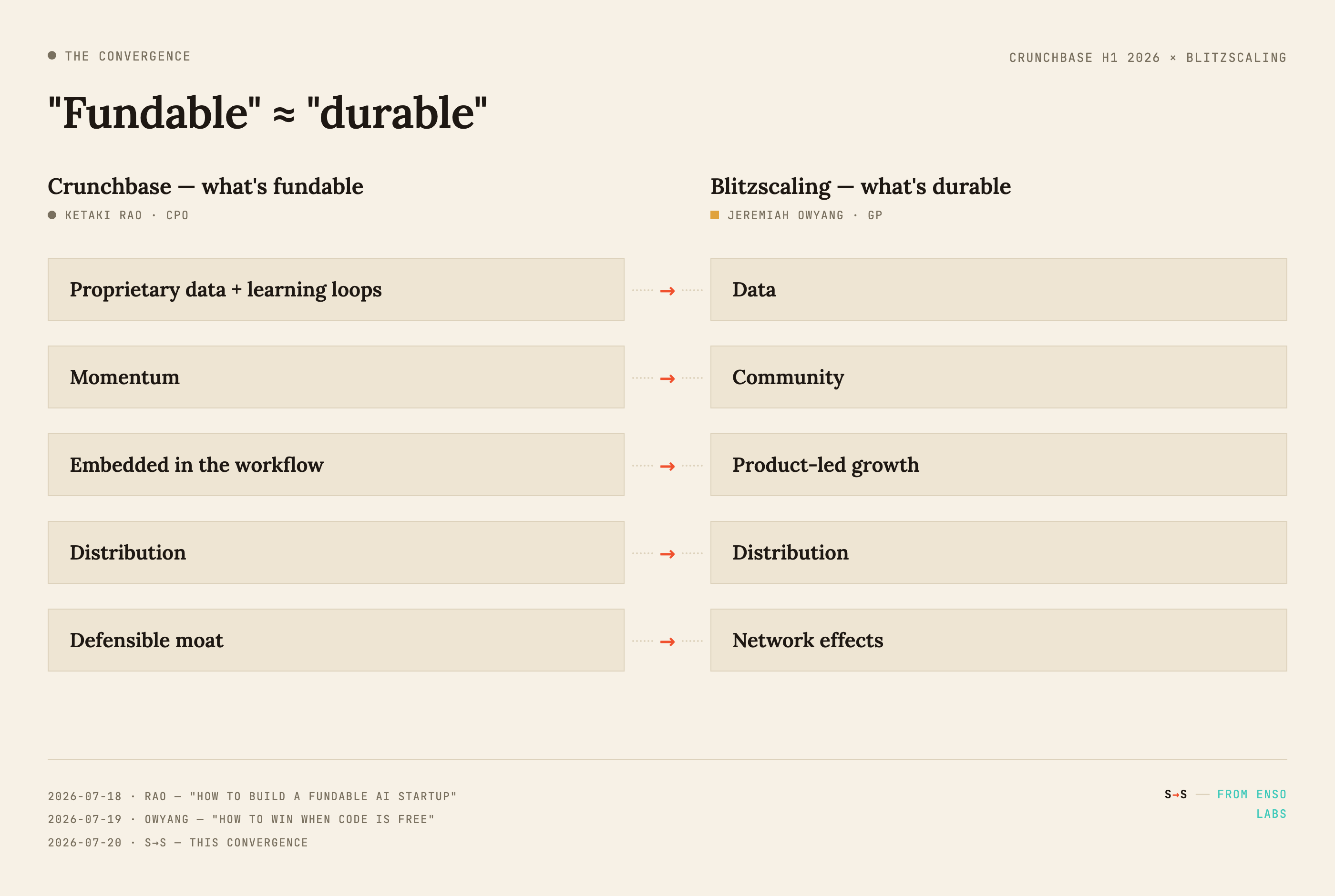
When the model is the commodity, the moat is everything the model isn't — the data, the community, the workflow seat, the distribution, and the effects that compound among them.
A ranking executive and a deploying investor arriving independently at the same conclusion is the kind of convergence we go to these rooms to catch. At 43 percent concentration, capital is already pricing the model layer as a commodity; what it pays for now is the rest.
The scorecard adds the warning label. Narrative at 82 and moat at 65 means the average AI startup's story is running 17 points ahead of its defenses. A concentrated market rewards that gap at seed — and collects on it at Series B, when the diligence question stops being "show us the demo" and becomes "show us what compounds."
The Enso take
This is the map we already build against. For a Fortune 500 manufacturer, the moat was never the model — it was encoding their scientists' judgment as inspectable, toggleable expert rules over data only they hold; the learning loop earns trust because the experts can watch it learn. For Heller's pharma AI Center of Excellence, the defensible position is the workflow seat: the system lives inside MLR and compliance review, the approval path every asset must clear — embedded, not adjacent. And Strategy to Ship, the engine publishing this article, is our own small flywheel: field notes from rooms like this one (data), the practitioners we meet there (community), published insights that do their own selling (product-led distribution), each piece compounding the next.
The pattern across all three: a moat is not a slide. It is operated — fed, measured, and defended weekly. That is the work we do: encoding what a company uniquely knows into managed agents, then running them in production, where the flywheel actually turns.
What to do about it
If you're building or buying AI and the moat conversation is overdue, get in touch — we're in SF through the Berkeley Agentic AI Summit on August 1–2.
Powered by Enso Labs
Frequently Asked Questions
What is the 'code is free' thesis from AGI Summit 2026?
Jeremiah Owyang, General Partner at Blitzscaling Ventures, argues that code and AI models are now commodities — a technical lead gets copied in weeks — so durable AI companies are built on a flywheel of data, community, product-led growth, distribution, and network effects. He presented it at AGI Summit 2026 (July 18–19, Palace of Fine Arts, San Francisco), with Composio's 1,000+ app-connection integration graph as the worked example of a moat that isn't code.
How concentrated was AI venture funding in H1 2026?
Global startup funding hit a record $510 billion in H1 2026 per Crunchbase — more than all of 2025 combined — but the money pooled rather than spread: more than 70% of Q2 capital went to AI companies (up from roughly 50% a year earlier), sixteen $1B+ rounds took 53% of Q2, and OpenAI and Anthropic alone absorbed $217 billion, 43% of the half.
What makes an AI startup fundable in 2026?
Crunchbase CPO Ketaki Rao's screen from AGI Summit 2026: a market with long-term potential, clear positioning, a defensible moat (proprietary data feeding learning loops, embedded in workflows, with a distribution advantage), momentum investors can trust, and narrative. Crunchbase's own scorecard ranked narrative highest (82) and differentiation lowest (53) for the average AI startup — the story is currently outrunning the defenses.
What makes an AI product defensible when models are commodities?
Everything the model isn't: proprietary data only you hold, a community only you convene, a seat inside the customer's workflow, distribution you own, and network effects that compound among them. Enso Labs encodes that domain advantage into managed agents and operates them in production — get in touch at https://ensolabs.ai/contact.
Want to scope an engagement around this?