

Berkeley is solving the supply side. The demand side is where agents die.
Across four stages and two days at Berkeley's Agentic AI Summit, not one session title names the customer. The buyer data says that is exactly where agentic projects fail — and it is a segmentation problem, not a model problem.
An agentic system fails in production not because the model cannot reason, but because nobody told it who it is serving, what that person is worth, and what it is allowed to say to them.
The signal
This weekend, 5,000-plus people arrive at UC Berkeley for the Agentic AI Summit 2026, hosted by Berkeley RDI across four stages — Plenary, Atlas, Nexus and Compass. It is sold out. It is the strongest single concentration of agentic AI talent scheduled this year: Dawn Song on safe and secure agents, Peter DeSantis on infrastructure, Andrew Ng with Alfred Lin, Sergey Levine on robot foundation models, panels on capital markets, finance and legal, plus workshops from Replit, Databricks, Ema, Temporal and Circle.
We read the full agenda twice this morning. Across four stages and two days, not one session title names marketing, advertising, brand, customer segmentation, customer experience, personalization or media. The closest the programme comes to the customer is a workshop on agentic commerce payment rails.
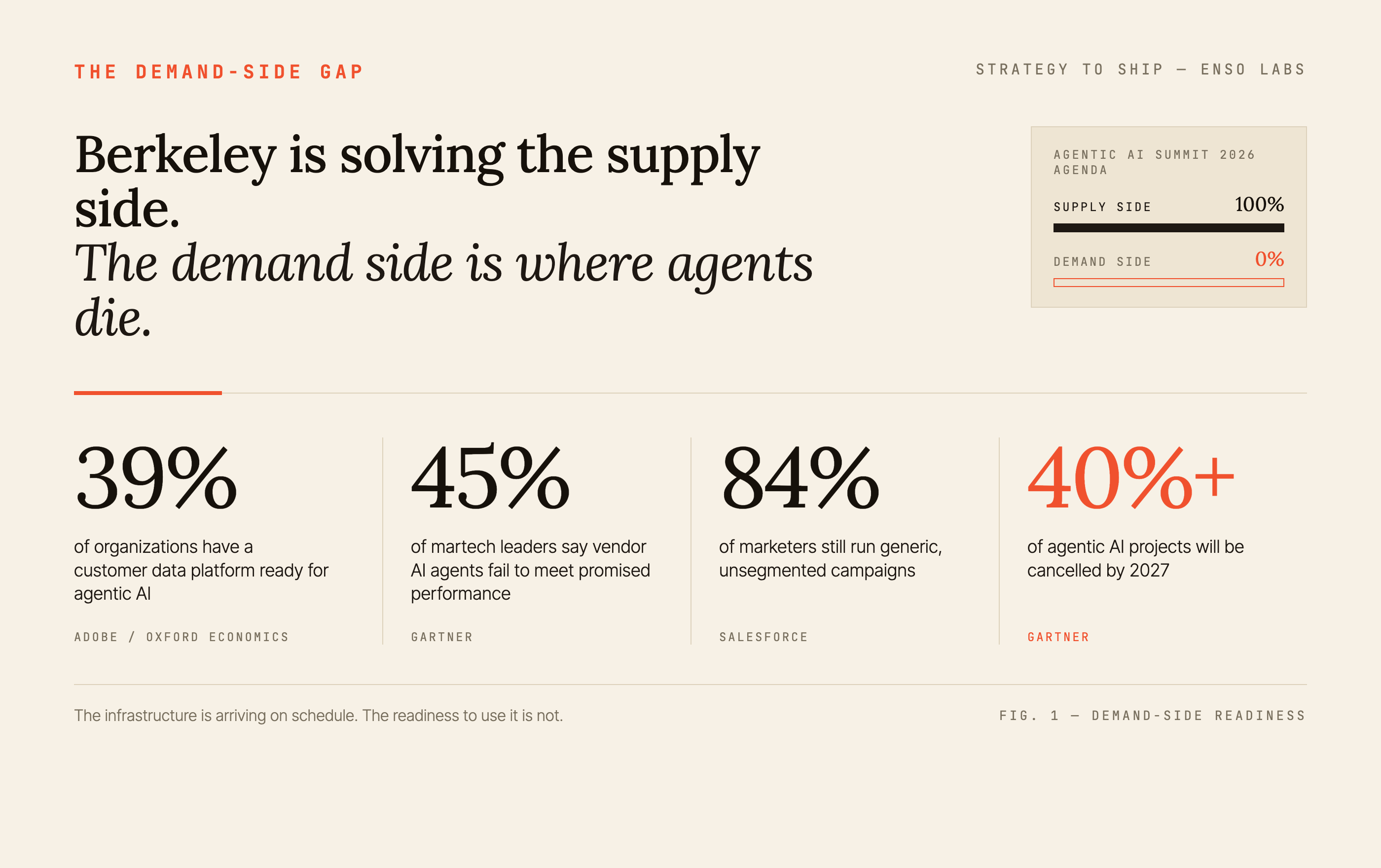
That is not a criticism of the programme. It is an accurate picture of where the field's attention sits. The agenda is infrastructure, foundational capabilities, frameworks, evaluation, security, robotics, and vertical applications. It is a supply-side agenda, and the supply side is being solved with extraordinary force. Gartner forecasts worldwide AI spending of $2.59 trillion in 2026, up 47% (19 May 2026), with $585.5B of it in AI services. Global venture funding hit $510B in H1 2026, with more than 70% of second-quarter capital going to AI (Crunchbase, 2 Jul 2026).
Now look at the other side of the transaction.
Only 39% of organisations have a shared customer data platform capable of supporting agentic AI, and 52% say data quality and accessibility actively limit their AI (Adobe/Oxford Economics, n=3,000 executives, 19 Feb 2026). Gartner's 2026 CMO Spend Survey found CMOs now allocate 15.3% of marketing budget to AI while only 30% consider themselves mature enough to scale it (n=401, 11 May 2026). 45% of martech leaders say the AI agents their existing vendors ship fail to meet promised business performance; 50% say their data and tech stack is not ready (Gartner, n=413, 29 Oct 2025). And 84% of marketers admit they are still running generic campaigns (Salesforce, n=4,450, 19 Feb 2026).
Why it matters
Put those two pictures side by side and the failure rate stops being mysterious.
Gartner expects more than 40% of agentic AI projects to be cancelled by the end of 2027 — on escalating cost, unclear business value, and inadequate risk controls (25 Jun 2025). In a separate prediction, it expects 40% of enterprises to demote or decommission autonomous agents by 2027 because governance gaps surfaced only after a production incident (26 May 2026).
Read the stated causes closely. *Unclear business value* is a segmentation failure — nobody quantified which customers the agent serves or what they are worth. *Inadequate risk controls* is a messaging failure — nobody defined what the agent may promise on the brand's behalf. *Governance gaps found in production* is a briefing failure — the constraints existed in someone's head and never made it into the system.
None of those are model problems. They are the disciplines that ran on Madison Avenue for forty years before anyone called it AI: who is the audience, what is the proposition, what is the evidence, what may we claim, and how will we know it worked.
The commercial stakes just moved too. Gartner now puts $234 billion of enterprise application software spend at risk from agentic AI, with vendors forced to move from interface-based value to outcome-based value (1 Jul 2026). Outcome-based value is not a pricing tweak. It means the party who defines the outcome — the segment, the offer, the acceptable answer — captures the margin. That party has historically been the agency and the CMO, not the systems integrator.
And the channel underneath all of it is moving. 68.01% of US Google searches now end without a click, up from 60.45% in 2024 (SparkToro/Similarweb, 9 Jun 2026), while AI Overviews appear on 43% of searches as of July 2026 versus 15% a year earlier (Similarweb, 27 Jul 2026). The first-party data and structured content that feed an agent are the same assets that decide what an answer engine says about you. One investment, two returns.
The Enso take
We build and operate agentic systems, so we will be specific — and we will use our own published numbers rather than someone else's survey.
Gartner expects more than 40% of agentic AI projects to be cancelled. Across our enablement programmes since 2022, our pilot-to-production conversion rate is 75%, with an average three-month time-to-first-value. We do not think that gap is about better engineering. It is about refusing to start until the brief exists.
The clearest case is a pharma AI Center of Excellence we have run since 2022. Five brand teams, FDA/MLR/PRC review on everything, active campaigns that could not be disrupted. We built the governance layer first — NIST AI RMF — then five brand knowledge bases, then eight automations with human-in-the-loop checkpoints at the regulatory gates. Results: campaign launch time down 83%, from three months to two weeks. 35% time savings. Zero compliance incidents.
Hold that last number against Gartner's second prediction — that 40% of enterprises will demote or decommission agents over governance gaps discovered only after a production incident. The reason we have not had that incident is not superior monitoring. It is that "what may this system claim, about which brand, to whom, under whose approval" was written down in week one, as a constraint the system enforces rather than a policy someone remembers.
On a Fortune 500 manufacturer engagement, the same principle in a different register: the system only became useful once we stopped treating domain expertise as retrieval and encoded it as toggleable, auditable rules an expert could switch off — an expert lens. In one pipeline run it processed 731 documents and surfaced 16 novel commercial signals. The unlock was not a better model. It was writing down, formally, what the system was permitted to conclude and for whom.
We are aware of how this reads, so we will name the bias directly: our founder spent fifteen years inside McCann, RAPP, DDB, BBDO, Y&R and Rokkan — that is IPG, Omnicom, WPP and Publicis — before building any of this. We know what the holding companies can do with an audience, and we know exactly why the work stops at the deck. Segmentation craft without production ownership produces a strategy. Production ownership without segmentation craft produces an agent nobody asked for. The scarce thing is both, in the same room, accountable to the same number.
Nothing at Berkeley this weekend is wrong. It is simply the other half of the problem. We will be there both days learning the supply side from the people building it — and arguing, in the hallways, that the next order of magnitude comes from the demand side.
What to do about it
If you are at Berkeley this weekend, we would like to argue about this in person. If you are not, we are running production-gap reviews for teams with agents live and results flat — the pharma AI Center of Excellence and enterprise enablement case studies are the shape of the work.
*This article was researched and drafted inside our own Strategy to Ship engine, which runs daily across 200+ sources. We use what we sell.*
Powered by Enso Labs
Frequently Asked Questions
Why doesn't Berkeley's Agentic AI Summit 2026 agenda include marketing or customer sessions?
Across four stages (Plenary, Atlas, Nexus, Compass) and two days, not one session title at Berkeley RDI's Agentic AI Summit 2026 names marketing, brand, customer segmentation, customer experience, personalization, or media — the closest is a workshop on agentic commerce payment rails. The agenda reflects where the field's attention currently sits: infrastructure, foundational capabilities, frameworks, evaluation, security, and robotics — a supply-side agenda, while the data shows the unresolved failure point is on the demand side.
Why do most agentic AI projects fail, according to Gartner?
Gartner predicts more than 40% of agentic AI projects will be cancelled by the end of 2027, citing escalating cost, unclear business value, and inadequate risk controls (25 Jun 2025). A separate Gartner prediction expects 40% of enterprises to demote or decommission autonomous agents by 2027 because governance gaps surface only after a production incident (26 May 2026). Read closely, those causes are segmentation, messaging, and briefing failures, not model failures.
How ready are companies to deploy agentic AI to customers?
Not very. Only 39% of organizations have a shared customer data platform capable of supporting agentic AI (Adobe/Oxford Economics, 19 Feb 2026). 45% of martech leaders say their vendors' AI agents fail to meet promised business performance (Gartner, 29 Oct 2025). And 84% of marketers admit they are still running generic, unsegmented campaigns (Salesforce, 19 Feb 2026).
How does Enso Labs approach the demand-side gap in agentic AI?
Enso Labs writes the brief — the segment an agent serves, its value, approved claims, and the success metric — before building the agent. Across its enablement programs since 2022, that produces a 75% pilot-to-production conversion rate and a three-month average time-to-first-value, against Gartner's industry-wide 40%+ cancellation rate. For Heller's pharma AI Center of Excellence, writing the governance and claims layer first produced an 83% cut in campaign launch time and zero compliance incidents. Get in touch at https://ensolabs.ai/contact.
Want to scope an engagement around this?