When code is free, distribution is the moat you can build.
Jeremiah Owyang's AGI Summit talk reframed defensibility as a five-stage growth flywheel — data, community, product-led growth, distribution, network effects. Four of those you accumulate over years; distribution is the one you can build this quarter through the right channel partners. Here is the flywheel as an operating plan, and how we're building the distribution stage on IBM Partner Plus.
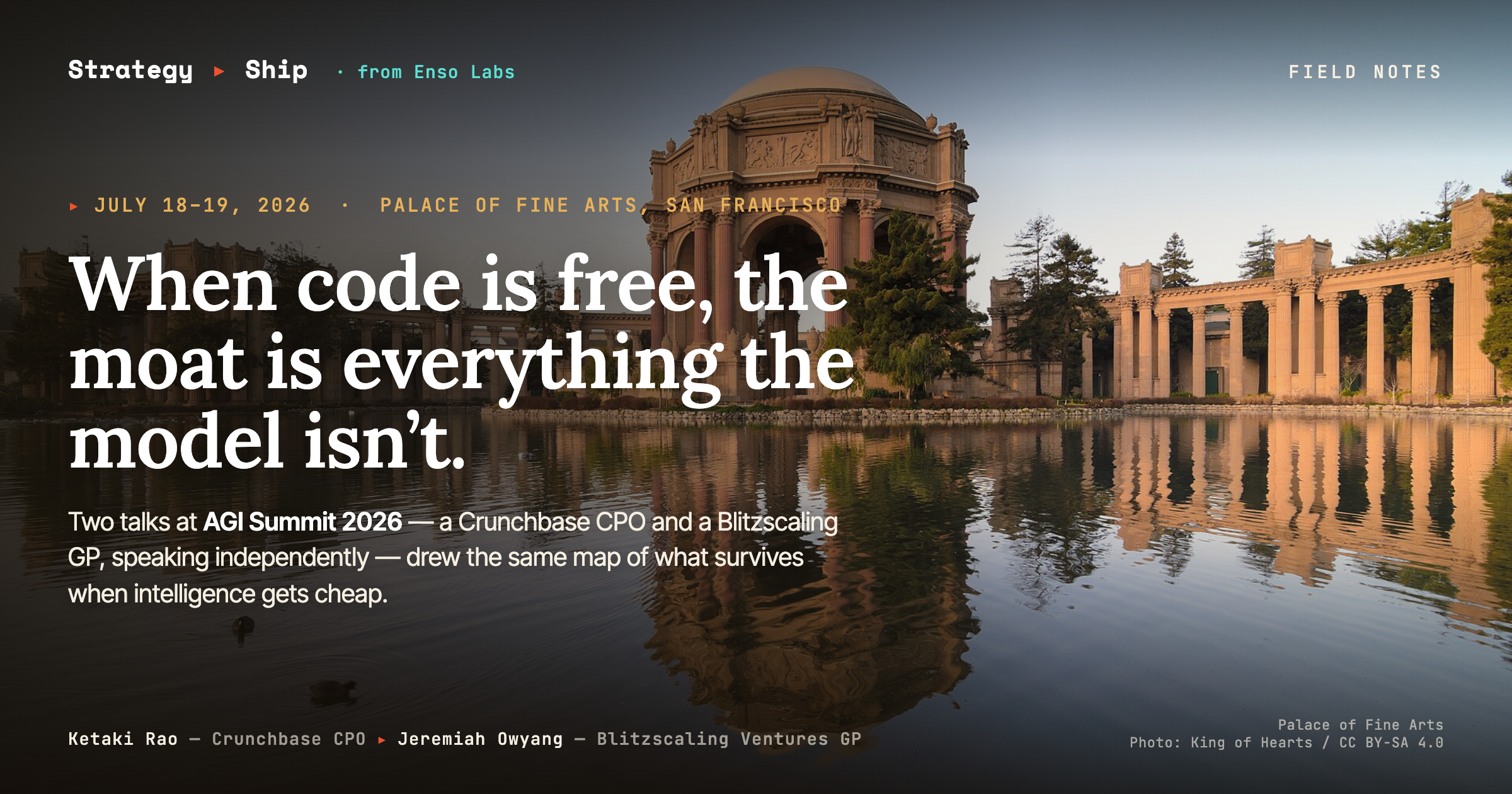
The most defensible AI company in 2026 is not the one with the best model — it is the one that has already built the distribution to reach a market before the model it runs on gets copied. Distribution is the moat you can build on purpose, and most teams build it last.
The signal
At AGI Summit 2026, Jeremiah Owyang — General Partner at Blitzscaling Ventures — gave a talk called "How to Win When Code Is Free." His premise is blunt: code is now a commodity. A clever technical lead gets copied in weeks, so he stops underwriting the code and underwrites the flywheel instead — Data → Community → Product-led growth → Distribution → Network effects, each stage feeding the next until the loop compounds.
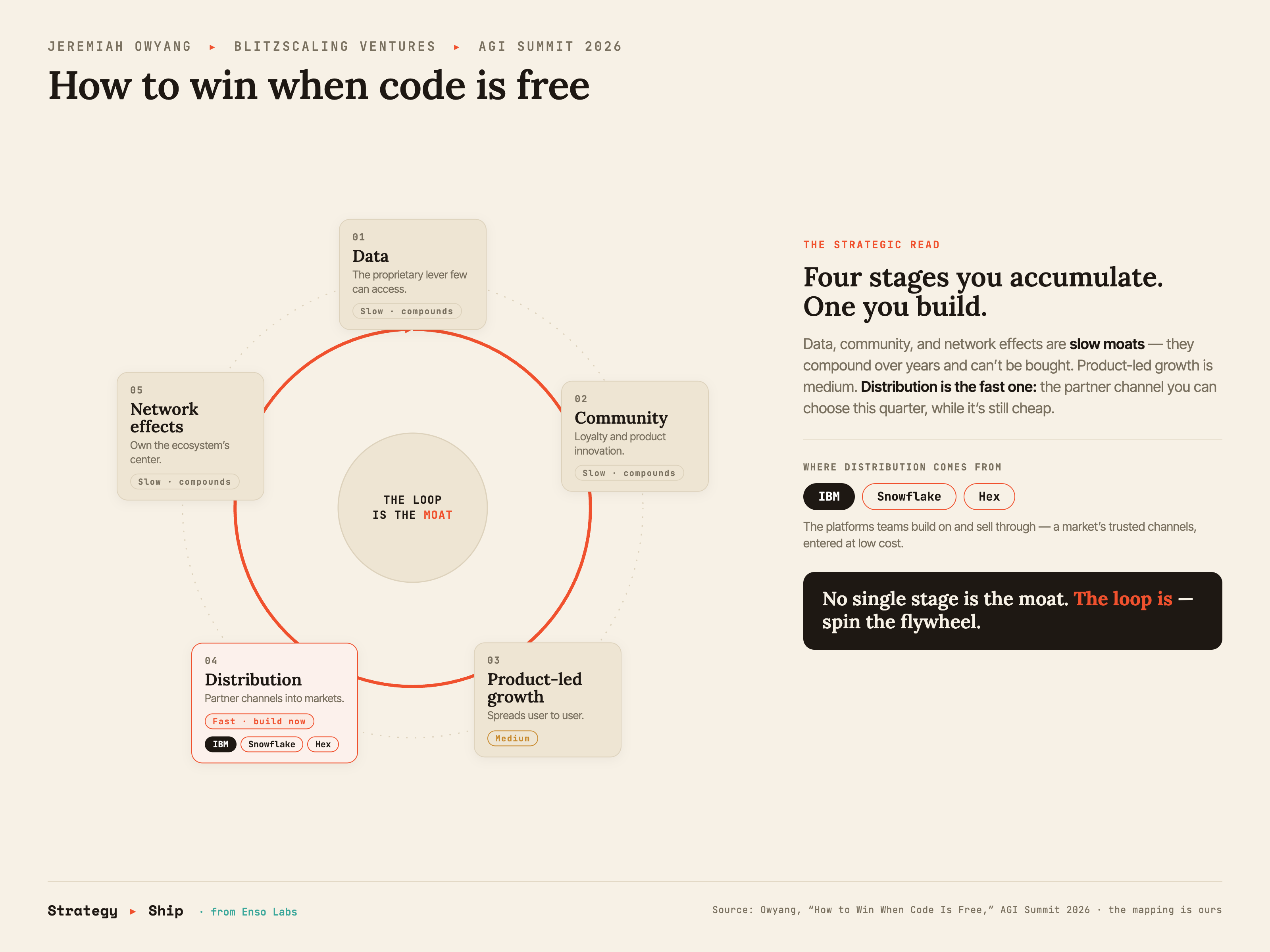
Read the flywheel as five different clocks. Data, community, and network effects are slow — they accrue over years and can't be bought. Product-led growth is medium — it depends on a product people want to pass along. Distribution is the fast one. It is the partner channel that puts a product in front of a market at low cost, and unlike the others, it is a decision you can make this quarter: which platforms do you build on, and sell through? Owyang's worked example, Composio, makes the point from the product side — 1,000-plus app connections turn the integration graph, not the code, into the thing a competitor would have to rebuild.
Why it matters
The market is already pricing the model layer as a commodity. Crunchbase's Chief Product Officer, Ketaki Rao, opened the same summit with her own data: global venture funding hit a record $510B in H1 2026, but it is pooling, not spreading — 43 percent of the half went to just two companies. When capital concentrates like that, the model is not the differentiator; it is the table stakes. What compounds is everything around it.
That is why distribution deserves more attention than it gets on a founder's roadmap. It is the stage that turns a good product into an unavoidable one — a seat inside the channels a buyer already trusts, rather than one more destination competing for an open tab. Get distribution right and it feeds network effects; network effects feed back into proprietary data; and the loop that started as a diagram becomes an operating plan.
The Enso take
This is the stage we are building right now. Enso is joining IBM Partner Plus on the Build track and building on watsonx, so the managed agents we operate can reach enterprise buyers through IBM's channel instead of one procurement conversation at a time. In Owyang's terms, that is the distribution stage made concrete: a partner channel that enters markets at low cost.
For a studio whose product is encoded domain expertise — the inspectable expert rules we built for a Fortune 500 manufacturer, or the compliance-embedded system inside Heller's pharma AI Center of Excellence — a platform channel is how that expertise reaches the enterprises it was built for.
We hold ourselves to the same flywheel we're describing. Strategy to Ship — the engine publishing this piece — is our own small loop: field notes from rooms like this one (data), the practitioners we meet there (community), and insights that do their own selling (product-led distribution), each piece compounding the next. The point of the flywheel is that no single stage is the moat. The moat is the loop.
What to do about it
If you're building or buying agentic AI and the distribution conversation is overdue, get in touch — encoding what your company uniquely knows into managed agents, then running them where your buyers already are, is the work we do.
Powered by Enso Labs
Frequently Asked Questions
What did Jeremiah Owyang mean by "how to win when code is free"?
At AGI Summit 2026, Blitzscaling Ventures GP Jeremiah Owyang argued that code is now a commodity — a technical lead gets copied in weeks — so investors underwrite a growth flywheel instead: Data → Community → Product-led growth → Distribution → Network effects, each stage feeding the next until the loop compounds. The moat is the loop, not any single stage.
Why is distribution the moat you can build fastest?
Of the five flywheel stages, data, community, and network effects are slow moats that compound over years and can't be bought, and product-led growth depends on a product people pass along. Distribution is the fast one: it is a decision you can make this quarter — which platforms you build on and sell through — via partner channels that enter a market at low cost.
How is Enso Labs building the distribution stage?
Enso Labs is joining IBM Partner Plus on the Build track and building on watsonx, so the managed agents it operates reach enterprise buyers through IBM's channel rather than one procurement conversation at a time. It is the distribution stage of the flywheel made concrete — a partner channel into the enterprise. Get in touch at https://ensolabs.ai/contact.
Want to scope an engagement around this?