

The best Forward Deployed Engineers have been forward deployed all along
The hottest role in AI is the Forward Deployed Engineer. But the scarce half of the job isn't the engineering — it's the forward: reading a business, defining what the system is for, and getting an organization to adopt it. That is the deployment strategist seat, and it comes straight from the Madison Avenue strategy disciplines: brand, digital, CX, and data.
A few weeks ago I was in a sold-out hall at UC Berkeley for the Agentic AI Summit 2026 — 5,000 people, four stages, and some of the sharpest builders in agentic AI in one place: Dawn Song, Peter DeSantis, Andrew Ng, Sergey Levine. Berkeley RDI had assembled the current frontier of the field, and between the sessions on secure and agentic AI, one question kept surfacing: who actually gets these systems into production?
For fifteen years I was a Director and VP of Strategy inside the holding companies — McCann, RAPP, DDB, BBDO, Y&R, and Rokkan, across IPG, Omnicom, WPP, and Publicis — running strategy for Citi, JPMorgan, American Express, Johnson & Johnson, Pfizer, Google, and Microsoft. Segmentation, account planning, journey mapping, CRM and data strategy, MECE problem-structuring: the disciplines that turn a messy business into a plan a company can act on. Standing in that hall at Berkeley, one thing clicked — those disciplines are exactly what decide whether an agentic deployment works.
If you lead a business and "agentic AI" still feels like someone else's language, here is the reassuring part: you do not need a new playbook, you need to see how the one you already run translates. Your segmentation becomes the audience an agent serves. Your creative brief becomes its system prompt. Your campaign measurement plan becomes its eval harness. Turning digital strategy into a deployed agent is the work now — and the market has a premium name for the person who does it.
A Forward Deployed Engineer is the person a software company embeds inside a customer to make the product actually work in the real world. Here is what nobody selling the role will tell you: the hardest part is not the engineering. It is the *forward* — reading a business you did not grow up in, deciding what the system is genuinely for, and getting a skeptical organization to adopt it. The people who have done that their whole careers did not come out of a computer science program. A lot of them came off Madison Avenue.
The signal
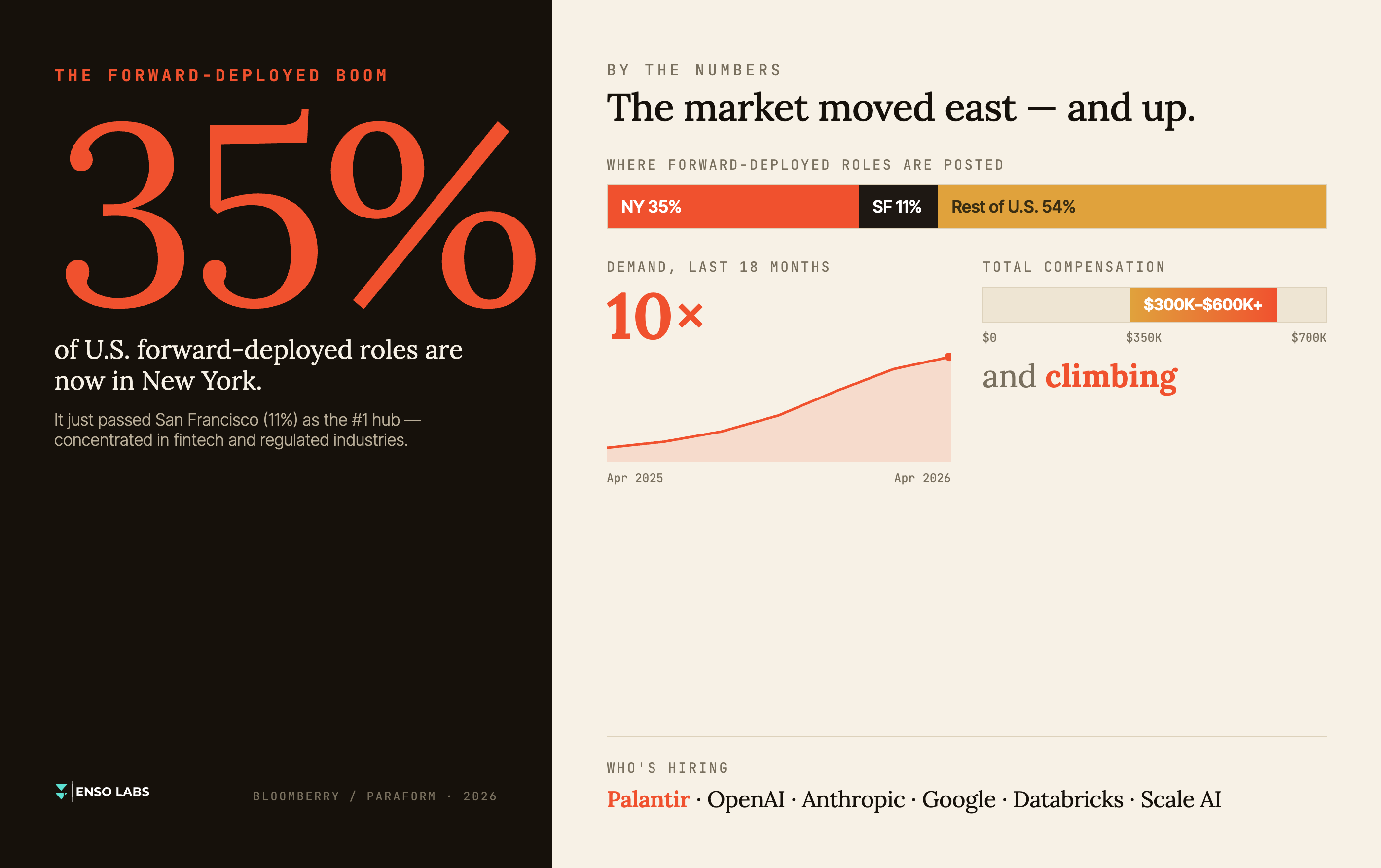
The Forward Deployed Engineer is the fastest-growing role in AI. Palantir invented it; OpenAI, Anthropic, Google, and Scale now hire it by name. Postings are up roughly 10x in eighteen months, total compensation runs $300K–$600K+, and here is the number that should stop any New York strategist mid-scroll: New York has overtaken San Francisco as the largest forward-deployed hub — about 35% of postings versus SF's 11% — concentrated in fintech and other regulated industries, exactly where compliance and integration have to be solved in the same breath.
Almost every job description frames it as an engineering role: full-stack or ML chops, RAG pipelines, eval frameworks, agent orchestration, production observability. All real. All, I would argue, the *teachable* half.
Forward deployment always had two seats
Here is the part the hiring frenzy forgets. Palantir, which invented this model, never sent one person. It sent two: a Forward Deployed Engineer who wrote the code, and a Deployment Strategist who translated organizational complexity into a plan, aligned the C-suite, and owned whether the thing actually got adopted. Read Palantir's own description of the strategist seat and it is not an engineer's posting — it is a strategist's: navigate a complex enterprise, define the outcome, drive the decision, own the deployment end to end.
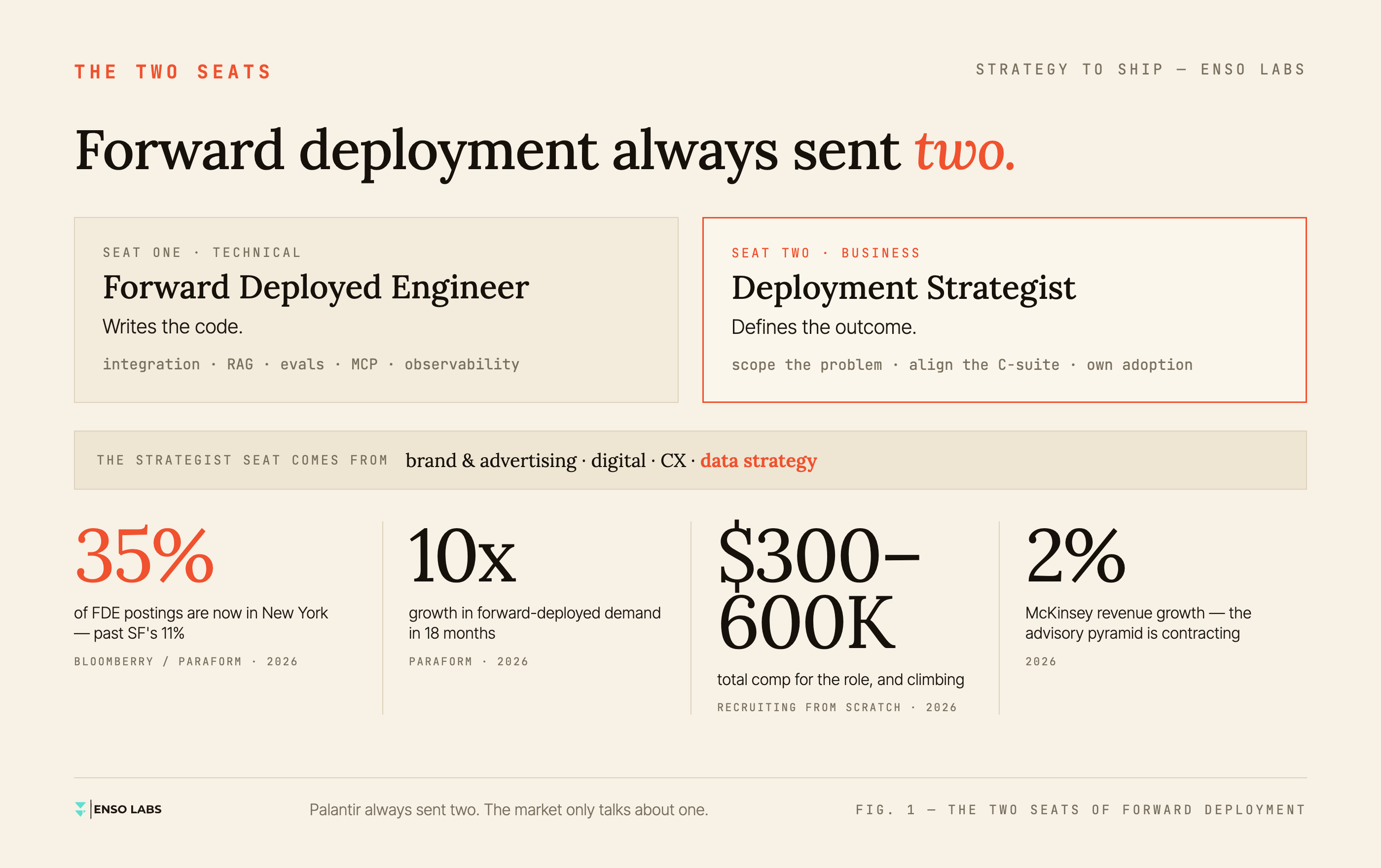
That seat is the one I have filled my entire career. It just was not called forward deployment. It was called account planning, digital strategy, CX strategy, and data strategy.
Why now: two models are shifting at once
The timing is not an accident. On the consulting side, the advisory pyramid is under pressure — McKinsey's revenue growth slowed to roughly 2% while headcount fell about 10%, and even as a quarter of its fees moved to outcome-based contracts, the message from inside the industry is clear: the team that maps a process for twelve weeks and hands back a deck is losing ground. On the agency side, the holding companies are contracting too — WPP's revenue fell 6.6% in Q1 2026, and holding-company revenue declined even as worldwide ad spend grew 8.6%. Both of the businesses that employed strategists are being told the same thing: move from the recommendation to the outcome.
The person who can do both — define the outcome *and* ship the system that delivers it — is the scarce one.
What agency strategy actually trains
These are the same skills wearing different job titles. In the agency world we called it one thing; in AI deployment it is called another.
Account and brand strategy becomes defining the outcome. In advertising this was the brief: who is the audience, what is the proposition, what are we allowed to claim. In an agentic system that is the system prompt, the guardrails, and the permission boundary — and the most common reason a deployment fails is that nobody wrote it down.
Digital strategy becomes technical discovery. Find where the experience breaks, scope where the model fits, map the integration surface, decide build-versus-buy.
CX strategy becomes workflow and human-in-the-loop design. Journey mapping is the work of deciding where an agent acts on its own, where it escalates to a person, and where the evaluation gate sits before anything reaches a customer.
Data and CRM strategy becomes the eval harness and retrieval quality. Segmentation, measurement, and data readiness are not adjacent to modern AI — they are it. The success metric, the RAG retrieval that has to be clean, the model-risk controls: that is a data strategist's native ground.
None of that is hand-waving about soft skills. It is the specific machinery of a production deployment — the harness of instructions, tools, evals, memory, observability, and guardrails around the model — described in the language of the people who have to buy it. I can write the brief and the eval harness. I speak McCann and I speak MCP.
The method never changed — only the medium did
Strip the eras apart and the process is identical. The agency strategist and the McKinsey consultant both ran a discovery-to-deployment method: interview the stakeholders, align the C-suite, structure the problem, write the brief, deploy, and measure. The forward-deployed AI strategist runs the same five phases — the creative brief becomes the system prompt, the campaign rollout becomes the agent in production, and the measurement plan becomes the eval harness.
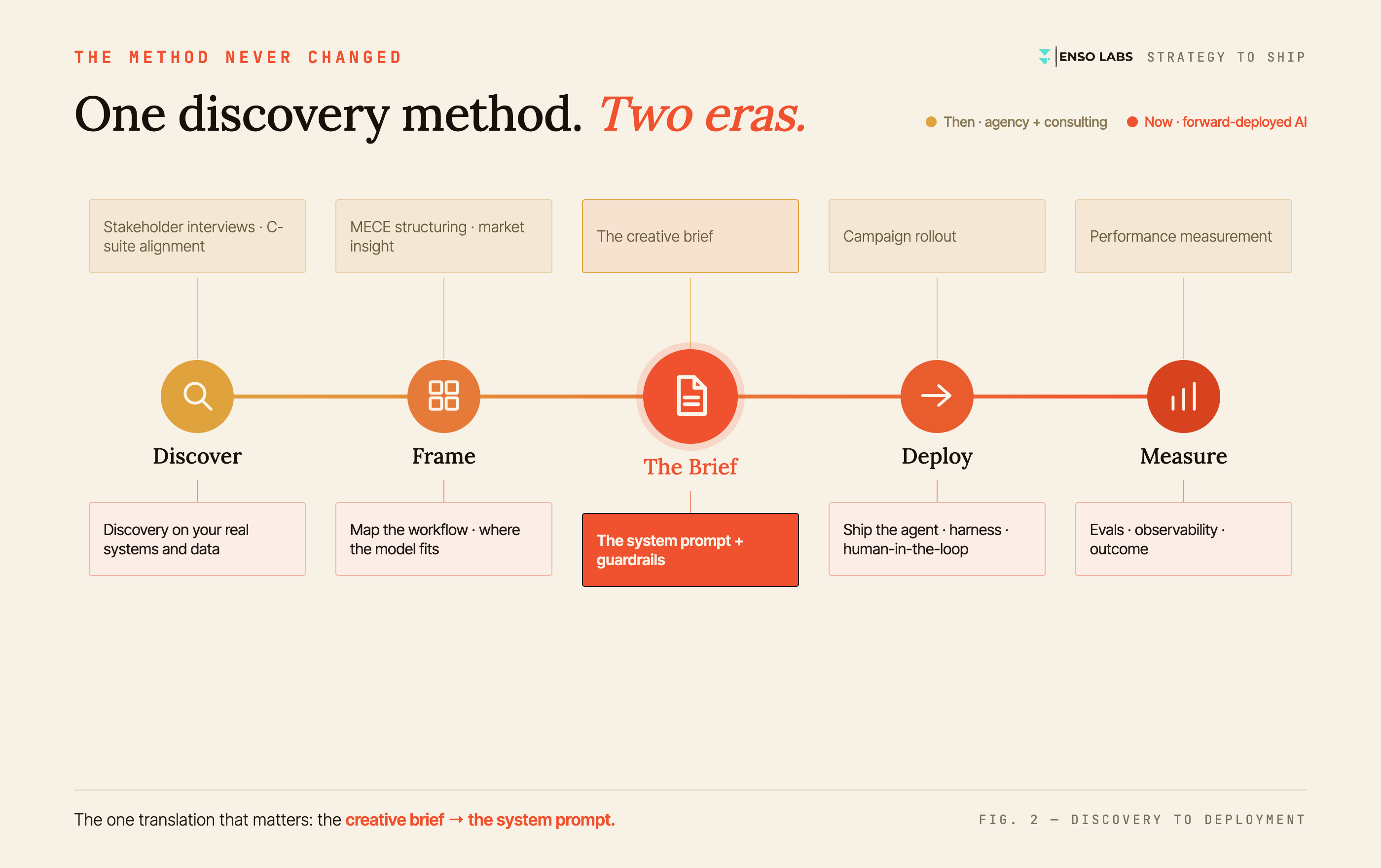
That is why the move is not a leap. The frameworks the holding companies and the strategy houses spent decades refining — MECE from McKinsey, account planning from the agencies — are the same frameworks that make an agentic deployment succeed. The strategist who learned to write a brief already knows how to specify an agent.
The half agencies never had — and AI just attached it
So if the overlap is this complete, why is not every agency strategist already a Forward Deployed Engineer? Because we were missing the last mile. The deck *was* the deliverable. We could specify the system; we could not ship it. Production ownership lived in a different building, and the strategy stalled on contact with engineering.
That is the part that changed. With Claude, the Model Context Protocol, and modern agent frameworks, the person who understands the business problem can now build and operate the solution — not describe it, run it.
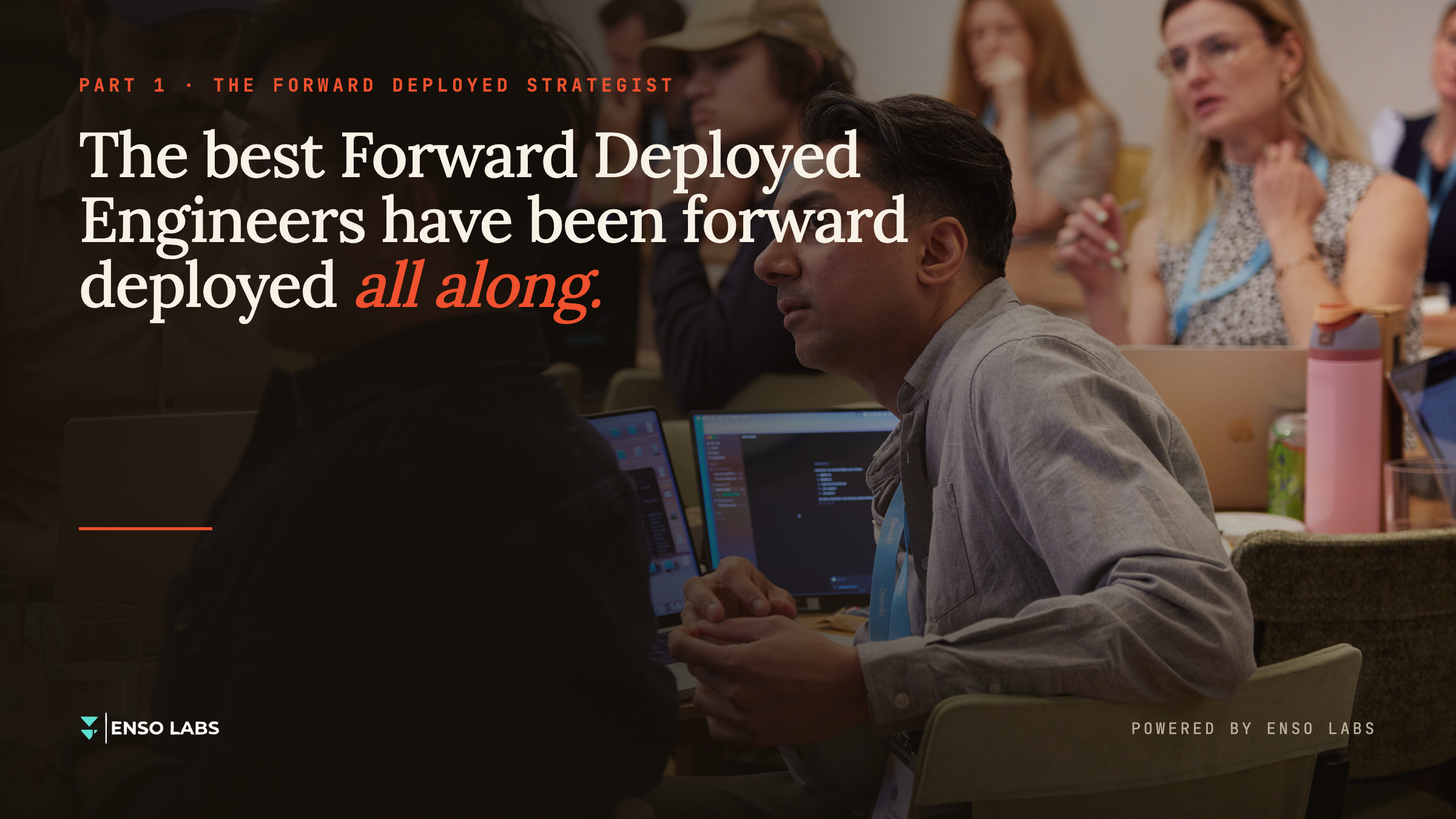
That is not theory for me; it is the last two years. At Enso Labs I stopped writing recommendations and started shipping systems: a financial AI trading terminal on Claude and MCP, live in production; an AI Center of Excellence for a pharma agency under full FDA/MLR review, with campaign launch time down 83%; and an expert-lens intelligence pipeline for a Fortune 500 manufacturer that processed 731 documents in one run and surfaced 16 novel commercial signals a lead scientist validated.
The industry is racing to teach engineers how to be forward. It might be faster to teach the forward how to engineer — and a lot of us already have.
Why an agency-trained strategist de-risks the deployment
The failure mode of enterprise AI is not that the model cannot reason. Gartner expects more than 40% of agentic AI projects to be cancelled by 2027 on unclear business value and inadequate controls — a segmentation failure and a governance failure, not a modeling failure. Those are demand-side problems, and demand-side problems are the strategist's home ground. This is the core of our forward-deployed AI strategy work and our financial services practice: define the audience, the proposition, the permitted claim, and the number, then build and operate the system that delivers them. And the enterprise version of that work is built on a foundation: IBM's Partner Plus program, where we operate as a Claude deployment partner — with IBM's Ethan Woods as our anchor — bringing Claude-native, governed agent delivery into watsonx-grade environments where data residency, model-risk controls, and auditability are the whole job, not an afterthought.
What to do about it
If your team has agents live and results flat, we run production-gap reviews. Get in touch.
*This is Part 1 of The Forward Deployed Strategist, a four-part series. Next: the harness is the product — what Berkeley's Agentic AI Summit revealed about deploying agents inside regulated industries.*
*Researched and drafted inside our own Strategy to Ship engine, which runs daily across 200+ sources. We use what we sell.*
Powered by Enso Labs
Frequently Asked Questions
What is a forward-deployed AI strategist?
The business-facing half of forward deployment — the seat Palantir pioneered as the deployment strategist. They embed inside an organization, scope the problem, align the C-suite, define the outcome and the success metric, and own adoption end to end, then ship the system that delivers it. It sits at the intersection of strategy, consulting, and hands-on delivery.
Is forward-deployed engineering only for people with an engineering background?
No. Palantir always paired an engineer with a deployment strategist, and the strategist role draws from management consulting, strategy, and — in Enso Labs' case — agency disciplines. Baseline technical fluency matters (agentic systems, RAG, evals, MCP, deployment strategy), but the scarce skill is reading the business and defining the outcome.
How does an advertising or consulting background map to AI deployment?
Directly. Brand strategy is defining the outcome and the permitted claims (the system prompt and guardrails). Digital strategy is technical discovery. CX strategy is workflow and human-in-the-loop design. Data strategy is the eval harness, retrieval quality, and the success metric. Same craft, new stack.
What AI skills should a forward-deployed strategist have?
Enough fluency to be credible: agentic system design, the agent harness (tools, evals, memory, observability, guardrails), RAG and retrieval quality, MCP and tool integration, human-in-the-loop escalation, and pilot-to-production deployment strategy — paired with the segmentation, brand-governance, and measurement craft that decides whether any of it lands with the business.
Want to scope an engagement around this?